
Since launching the Ready to Pass? campaign in 2022, we've had lots of useful feedback from many of you as approved driving instructors (ADIs). One theme that’s come up is that the campaign feels too focused on passing the test and not enough on the broader skills that make someone a safe driver for life.
That's fair feedback and we've taken it seriously. This post explains the changes we've made to the driving skills section of the campaign website, why we made them and how the new content might be useful in your lessons.
What the driving skills section is
The driving skills section of the Ready to Pass? website is a learner-facing resource that sets out the 27 skills at the heart of learning to drive.
It groups those skills into 8 categories: basics, control and positioning, observation and planning, junctions and crossings, manoeuvres, road types, driving conditions and driving independently. It also provides guidance on how learners can track their progress across 5 levels as they develop each one.
From ‘passing the test’ to ‘driving safely’
The most visible change is the title of the driving skills section itself. It's moved from ‘Skills you need to pass your driving test’ to ‘Learning the skills you need to drive safely’.
It now has a description that reads: "Discover the 27 skills you'll develop with your driving instructor and how to track your progress as you work towards becoming a safe, independent driver."
You'll see that framing carried through the language across the whole section.
Advice on choosing an instructor and checking badges
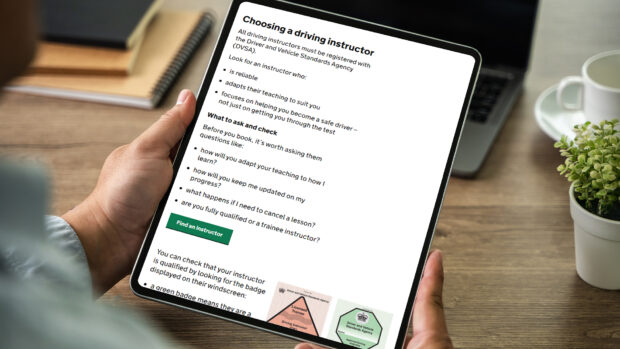
The section now includes clear guidance for learners on how to find a qualified instructor, what to look for and the difference between a fully qualified ADI and a trainee driving instructor. It also suggests questions learners might want to ask before booking.
A new navigation page
We've added a navigation page for the section, making it quicker and easier to get directly to any of the pages in the section.
This should make it simpler for your pupils to find specific skills quickly.
A recommended learning sequence
The updated section sets out a clear order for learning to drive:
- Choose a driving instructor.
- Start studying The Highway Code.
- Start taking driving lessons with your instructor.
- Start studying and practising for your theory test.
- Book and take your theory test when your instructor thinks you are ready.
- Start doing private practice between your driving lessons, when your instructor says you are ready.
- Book your driving test only when your instructor agrees you are ready to pass and drive on your own.
We've included this because DVSA survey data shows that learners who start professional lessons before their theory test are more likely to succeed. Learners without any lessons before their theory test were:
- 16% more likely to fail the multiple-choice part of theory test first time
- 25% more likely to fail their driving test first time
These figures come from voluntary surveys of learner drivers carried out by DVSA. The theory test data covers responses collected between April 2024 and July 2025. The driving test data covers responses collected between July 2024 and April 2025.
This sequencing reinforces your role as the expert in judging readiness - which is central to what the whole campaign is trying to communicate to learners.
Reflective questions for each skill
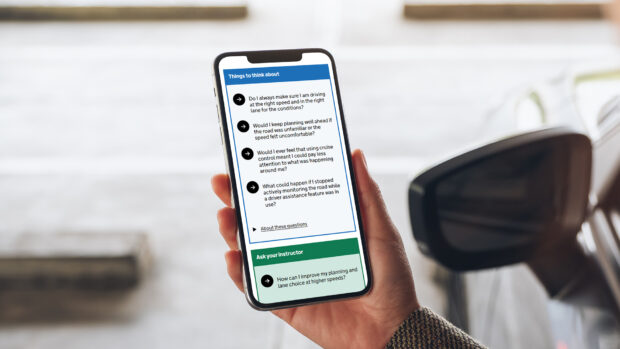
Each of the 27 individual skill pages now includes 4 questions under the heading ‘Things to think about’ and 104 questions in total across the section. These follow a deliberate structure:
- do I... (habit)
- would I... (scenario)
- would I ever... (beliefs and values)
- what would happen if... (consequence)
This progression mirrors how the brain processes behaviour and moves learners from surface-level awareness toward deeper self-evaluation skills. The questions are written at an accessible reading level and framed as tools for reflection, not a test.
Although they’ve been designed for learners to use as private self-reflection, you may find some of them are useful as conversation starters in lessons. They might be particularly helpful with learners who find it difficult to talk about their driving, or who need encouragement to reflect beyond the mechanics of what they did.
An ‘ask your instructor’ prompt for each skill
Each of the 27 skills also includes a single prompt under a heading of ‘Ask your instructor’. These are designed to encourage learners to initiate coaching conversations with you, raising topics they might not otherwise bring up.
The questions are intentionally open-ended and aligned with coaching principles, inviting learners to take an active role in their own development rather than waiting to be told what to improve.
Skills updated with content on advanced driver assistance systems
Many modern vehicles include systems such as lane assist, automatic emergency braking and parking sensors.
We've added what learners need to know and understand about them.
Take a look and tell us what you think
View the updated driving skills section.
This content has been shaped by ADI feedback, but we know the real test of whether it works will be in your lessons.
If you try the reflection questions or if your pupils use the ‘Ask your instructor’ prompts, please let us know what happened, such as what worked, what fell flat and what you'd change.
We read every response and your feedback will directly inform how we develop this section further. Email ready.to.pass@dvsa.gov.uk - we'd genuinely like to hear from you.
We’ll now be turning our attention to improving the ‘Helping a learner driver’ section of the website. This is the section for parents, guardians and other people supporting learners. We’ll update you when it’s relaunched.
12 comments
Comment by Tim Clayton posted on
I like lots in this, especially the basis in psychology.
However, my experience teaching more than 500 learners is that they seem to respond no worse/better when I don’t “walk them through things” linearly or particularly sequentially. Very few are so inexperienced that they won’t deduce three-quarters of what’s going on for themselves.
My job is, broadly, (1) easy rapport; (2) safety on the move; and (3) spotting gaps and helping them back-fill .
It may be because I don’t teach many 17-25 year olds. Open question: is Ready to Pass ‘geared’ toward the known demographic ADIs teach?
Comment by Lucy posted on
Hi Tim,
Thank you for your comment and for sharing your experience.
The content is intended to support the broad range of people learning to drive, and we've used feedback from driving instructors to help shape these updates.
We recognise that instructors adapt their approach to suit the needs, experience and learning style of each individual learner.
Feedback from instructors with different teaching approaches and learner demographics is always valuable, so thank you for sharing your perspective.
Comment by Tim Clayton posted on
Advice on choosing an instructor is vital. (That rightly forces we self-employed to promote our successes as best we may).
What about advice on choosing an instructor trainer? I’m long enough in the industry to have heard PDIs’ poor experiences.
If a parallel “Ready to Teach?” campaign is run, please include material by which prospective PDIs can ask hard questions of the trainers they’re considering.
Comment by Lucy posted on
Hi Tim,
Thank you for your comment.
The Ready to Pass? campaign is focused on supporting learner drivers, but we appreciate your suggestion and the value of helping prospective PDIs make informed decisions.
We'll share this feedback with colleagues as part of our ongoing work with the driver training industry.
Thank you for taking the time to share your thoughts.
Comment by Andy Hughes posted on
Totally agree with the focus on safe driving, however the client pays the bill and they generally refer to wanting to pass their driving test. With this in mind, I feel there is a huge missing in your ready to pass site. The very name is "ready to pass" which I think there is nothing wrong with. Learners want to pass a test. Instructors are the ones who want to ensure that the person taking the test is a safe driver. So it's semantics and assumed really. However, you absolutely miss the fact that the actual driving test itself, terrifies many people. By the time they walk out to the car with the examiner, psychologically they've changed into a different person. Therefore they are no longer driving like themselves. I would guarantee that of the, nearly 60% of people who fail their test, at least half of these would have passed had they been tested by their driving instructor was part of a normal lesson. My feeling is that you are in danger of ignoring once of the biggest contributors to the current poor test pass rates.
Comment by Lucy posted on
Hi Andy,
Thank you for your feedback.
We agree that test nerves can have a significant impact on some learners, and that being able to drive well in lessons does not always translate into performing at their best on test day. Our own research shows that around 1 in 10 people who have failed say the main reason was nerves.
While the newly updated section focuses on driving skills, the Ready to Pass? website also includes guidance to help learners manage driving test nerves. We are planning on making significant additions to this section in response to feedback from both learners and ADIs. We also encourage learners to take mock tests, which can help them become more familiar with test conditions and feel more prepared for the real test.
Thank you for sharing your experience.
Comment by Paul Longshaw posted on
Section 6 - Private practice seems to assume all learners have easy access to a vehicle for private practice. In over 20 years as an ADI I have found a very small percentage of pupils actually have access to a vehicle. Parents with company cars, massive suv's, automatic or electric cars not aligned with my training vehicle or high powered cars not suitable for learning all mean most of my students only have access to my vehicle.
Comment by Lucy posted on
Thanks for your comment, Paul.
We recognise that access to a suitable vehicle for private practice is not possible for every learner, and the guidance is not intended to assume that everyone has that opportunity.
Where private practice is available, we encourage learners to use it alongside professional lessons and with their instructor's guidance. However, we know that many learners will rely solely on lessons with their ADI, and instructors remain central to helping them develop the skills, knowledge and experience needed to become safe drivers.
We appreciate you sharing your experience, and feedback like this helps us continue to improve the guidance for learners and those supporting them.
Comment by David. posted on
These prompts will help them not to miss the forest for the trees.
* What information did you use to make that decision, and what did you ignore?
* If you had another chance, what would you do differently, and why?
* What was the biggest risk in that situation, and how did you manage it?
* How far ahead were you planning, and what evidence tells you that?
* What clues told you it was safe to continue?
* What could another road user reasonably have expected you to do?
* How did your observations influence your speed and positioning?
* What was your backup plan if the situation changed unexpectedly?
* What early warning signs did you notice before the hazard developed?
* If you were teaching this skill to someone else, what would you emphasise first?
* How could you complete the same manoeuvre with an even greater safety margin?
* What did you do well, and how will you repeat that consistently?
* What habits are you developing that will still serve you in five years’ time?
* How would an advanced police driver assess your decisions in that situation?
These prompts go beyond simply asking, “How did that go?” They develop hazard perception, risk management, planning, decision-making, and self-evaluation—the skills that create safer, more independent drivers.
I’ve got more this is nothing so to speak.
Kind regards.
Comment by Lucy posted on
Hi David,
Thanks ever so much for the feedback and sharing prompts that you use – they are great.
Questions like "What habits are you developing that will still serve you in five years?" exemplify exactly the kind of reflection the campaign is trying to encourage.
We will consider if there are opportunities to expand the questions in this section to help learners further develop their skills and understanding.
Thank you for taking the time to comment.
Comment by Ian Thomas posted on
A great start so far. Fully agree with changing Test criteria from learning to pass the Test to assessing to be a safe driver. Mind set and response skills are vital to good sensible driving which are nkt considered in present Test assessment.
Also the learning sequence is a positive reflection on How to go about learning to drive. My simple approach is to start a learner with 1) What they THINK they know 2) What they DO know 3) What they NEED to know 4) KNOWING what to do is no good unless they can DO IT.
A SAFE driver will do it consistently with little thought and by HABIT.
(HAve ABility and do IT)
Comment by Lucy posted on
Hi Ian,
Thank you for your comment and for sharing your approach.
We're pleased that you support the updates. One of the key aims of these updates is to encourage learners to focus not just on what they need to know, but on building the skills, experience and habits that help them drive safely and independently.
Thank you for taking the time to comment.